The official Highway Code

Road markings

Road markings used, including those across the carriageway, along the carriageway, along the edge of the carriageway, on the kerb or at the edge of the carriageway and other road markings.

★ 4.7 · 2,731 reviews 800,000+ learners ✓ Trading Standards
Studied this chapter?

Book your DVSA theory test with unlimited re-sits* and complete theory test prep in one place.

Book my theory test now

Across the carriageway

Stop line at signals or police control

Stop line at signals or police control

Stop line at β€˜Stop’ sign

Stop line at β€˜Stop’ sign

Stop line for pedestrians at a level crossing
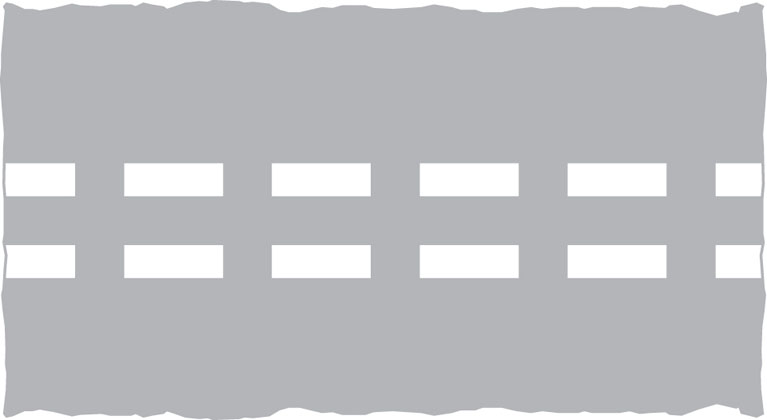
Stop line for pedestrians at a level crossing

Give way to traffic on major road (can also be used at mini roundabouts)

Give way to traffic on major road (can also be used at mini roundabouts)

Give way to traffic from the right at a roundabout

Give way to traffic from the right at a roundabout

Give way to traffic from the right at a mini-roundabout

Give way to traffic from the right at a mini-roundabout

Along the carriageway

Edge line

Edge line

Centre line See Rule 127

Centre line See Rule 127

Hazard warning line See Rule 127

Hazard warning line See Rule 127

Double white lines See Rules 128 and 129

Double white lines See Rules 128 and 129

Double white lines See Rules 128 and 129

Double white lines See Rules 128 and 129

See Rule 130

See Rule 130

Lane line See Rule 131

Lane line See Rule 131

Along the edge of the carriageway

Waiting restrictions indicated by yellow lines apply to the carriageway, pavement and verge. You may stop to load or unload (unless there are also loading restrictions as described below) or while passengers board or alight. Double yellow lines mean no waiting at any time, unless there are signs that specifically indicate seasonal restrictions. The times at which the restrictions apply for other road markings are shown on nearby plates or on entry signs to controlled parking zones. If no days are shown on the signs, the restrictions are in force every day including Sundays and Bank Holidays.White bay markings and upright signs (see below) indicate where parking is allowed.
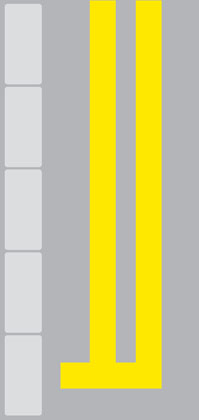
No waiting at any time
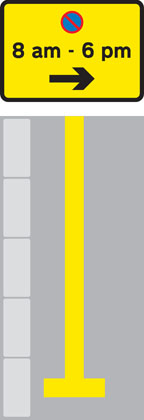
No waiting at any time

No waiting during times shown on sign
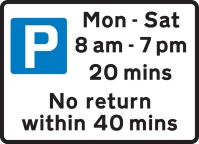

No waiting during times shown on sign

Waiting is limited to the duration specified during the days and times shown

Waiting is limited to the duration specified during the days and times shown

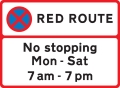
Red lines are used on some roads instead of yellow lines. The double and single red lines used on Red Routes indicate that stopping to park, load/unload or to board and alight from a vehicle (except for a licensed taxi or if you hold a Blue Badge) is prohibited. The red lines apply to the carriageway, pavement and verge. The times that the red line prohibitions apply are shown on nearby signs, but the double red line ALWAYS means no stopping at any time. On Red Routes you may stop to park, load/unload in specially marked boxes and adjacent signs specify the times and purposes and duration allowed. A box MARKED IN RED indicates that it may only be available for the purpose specified for part of the day (eg between busy peak periods). A box MARKED IN WHITE means that it is available throughout the day.

RED AND SINGLE YELLOW LINES CAN ONLY GIVE A GUIDE TO THE RESTRICTIONS AND CONTROLS IN FORCE AND SIGNS, NEARBY OR AT A ZONE ENTRY, MUST BE CONSULTED.
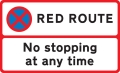
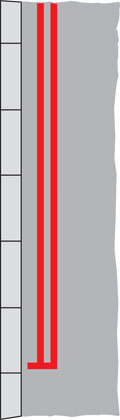
No stopping at any time
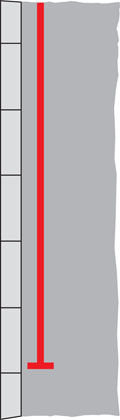
No stopping at any time

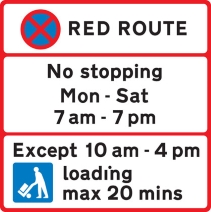
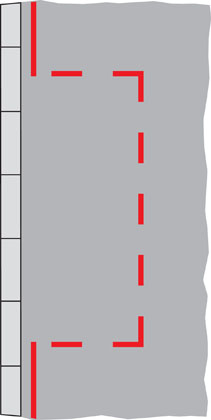
No stopping during times shown on sign
No stopping during times shown on sign

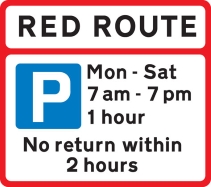
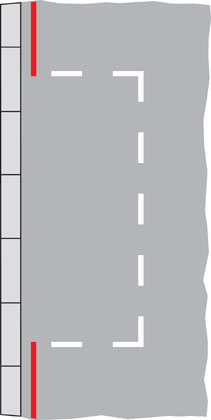
Parking is limited to the duration specified during the days and times shown
Parking is limited to the duration specified during the days and times shown

Only loading may take place at the times shown for up to a maximum duration of 20 mins

Only loading may take place at the times shown for up to a maximum duration of 20 mins

On the kerb or at the edge of the carriageway

Yellow marks on the kerb or at the edge of the carriageway indicate that loading or unloading is prohibited at the times shown on the nearby black and white plates. You may stop while passengers board or alight. If no days are indicated on the signs the restrictions are in force every day including Sundays and Bank Holidays.

ALWAYS CHECK THE TIMES SHOWN ON THE PLATES.

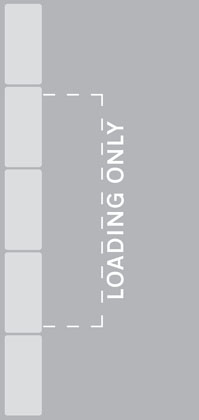
Lengths of road reserved for vehicles loading and unloading are indicated by a white β€˜bay’ marking with the words β€˜Loading Only’ and a sign with the white on blue β€˜trolley’ symbol. This sign also shows whether loading and unloading is restricted to goods vehicles and the times at which the bay can be used. If no times or days are shown it may be used at any time. Vehicles may not park here if they are not loading or unloading.
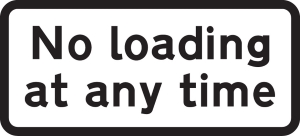
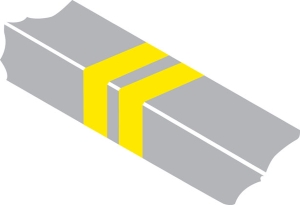
No loading or unloading at any time

No loading or unloading at any time

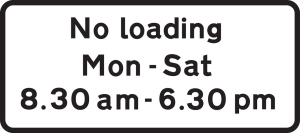
No loading or unloading at the times shown

No loading or unloading at the times shown

Loading bay

Loading bay

Other road markings

Keep entrance clear of stationary vehicles, even if picking up or setting down children

Keep entrance clear of stationary vehicles, even if picking up or setting down children

Warning of β€˜Give Way’ just ahead

Warning of β€˜Give Way’ just ahead

Parking space reserved for vehicles named
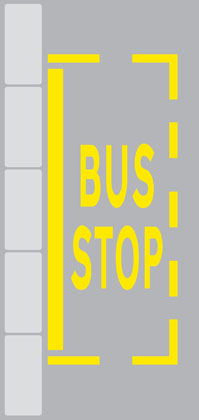
Parking space reserved for vehicles named

See Rule 243
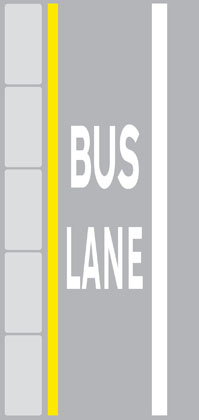
See Rule 243

See Rule 141

See Rule 141

Box junction - See Rule 174
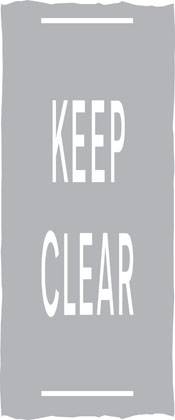
Box junction - See Rule 174

Do not block that part of the carriageway indicated
Do not block that part of the carriageway indicated

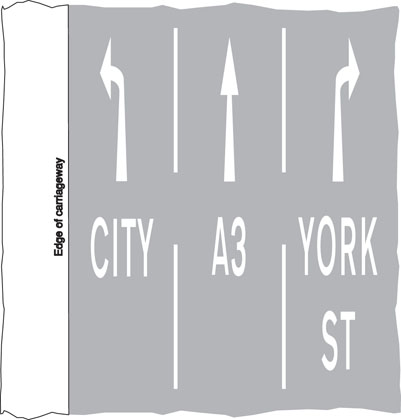
Indication of traffic lanes

Indication of traffic lanes

Industry leading reviews from 2731 verified buyers...

Keep up to date with us on social media...

Want to book your theory test and sort your revision at the same time? πŸ“…πŸš— Our Β£49 car and motorcycle package includes your DVSA theory test booking, practice materials and unlimited re-sits. See what's included πŸ‘‡ https://www.drivingtheory4all.co.uk/book-theory-test #booktheorytest
23 hours ago
Approaching an unfamiliar road junction? πŸš— Good observations, correct positioning and understanding priority are essential. Revise T-junctions, crossroads and other UK road junction rules πŸ‘‡ https://www.drivingtheory4all.co.uk/learning-to-drive/road-junctions #theorytest #learnerdriver
1 day ago
Do you know the difference between a no waiting sign and a no stopping sign? πŸš«πŸš— They mean different things, and both are worth knowing for your driving theory test. Learn the no waiting sign πŸ‘‡ https://www.drivingtheory4all.co.uk/road-signs/no-waiting-sign #roadsigns #theorytest
1 day ago
Who's responsible for making sure a child wears the correct seat belt or restraint? πŸš— For children under 14, it's the driver's responsibility. Brush up on the UK child car seat and seat belt rules πŸ‘‡ https://www.drivingtheory4all.co.uk/learning-to-drive/child-car-seat-and-seat-belt-rules #theorytest
2 days ago
How well do you know your UK road markings? πŸ›£οΈ From double white lines to give way markings and yellow lines, knowing what they mean is important for your theory test. Revise the Highway Code road markings πŸ‘‡ https://www.drivingtheory4all.co.uk/highway-code-road-markings #highwaycode
2 days ago
What's the difference between zebra, pelican, puffin and toucan crossings? 🚦🚢 Each has different features and rules that learner drivers need to understand. Revise pedestrian crossings before your theory test πŸ‘‡ https://t.co/oTcKEdVtHV #highwaycode #theorytest
3 days ago
Working towards your HGV/LGV licence? πŸš› Prepare for theory test Parts 1a and 1b with DVSA-licensed questions, hazard perception videos and unlimited mock tests. 60 days' web and app access from Β£14.99 πŸ‘‡ https://www.drivingtheory4all.co.uk/lgv-theory-test #hgvtheorytest
3 days ago
Want some FREE driving theory test practice? πŸ“πŸš— Choose your test type and try DVSA revision multiple-choice theory test questions with answers and explanations. Car, motorcycle, HGV/LGV, PCV and ADI practice available πŸ‘‡ https://www.drivingtheory4all.co.uk/free-practice-theory-test #theorytestpractice
4 days ago
Does the national speed limit sign always mean 70 mph? πŸš—πŸ›£οΈ No. The limit depends on the type of road and vehicle you're driving. Make sure you know the UK speed limits before your theory test πŸ‘‡ https://www.drivingtheory4all.co.uk/learning-to-drive/speed-limits #highwaycode #theorytest
4 days ago
Struggling with certain car theory test topics? πŸš—πŸ“š Revise with DVSA-licensed questions, explanations, hazard perception clips and unlimited mock tests. Get 365 days of car theory test practice from Β£5.99 πŸ‘‡ https://www.drivingtheory4all.co.uk/car-theory-test-practice #cartheorytest
4 days ago
Need to reschedule your theory test? πŸ“… You can change your DVSA theory test date, time or test centre online. You'll normally need at least 3 full working days' notice to avoid paying again. Read our guide πŸ‘‡ https://www.drivingtheory4all.co.uk/change-theory-test #theorytest
4 days ago
Passed your theory test a while ago? πŸ“…πŸš— Your car theory test pass certificate is valid for 2 years. If it expires before you pass your practical test, you'll need to take the theory test again. Check the rules πŸ‘‡ https://www.drivingtheory4all.co.uk/how-long-is-a-theory-test-valid #theorytest
4 days ago
Do you understand why an answer is correct, or are you just remembering it? πŸ€”πŸ“ Try FREE UK theory test questions and answers, with explanations to help you learn the rules behind each question. Choose your test type πŸ‘‡ https://www.drivingtheory4all.co.uk/theory-test-questions-and-answers #theorytestpractice
1 week ago
Which driving theory test are you preparing for? πŸš—πŸοΈπŸš› Car, motorcycle, HGV, PCV or ADI - find theory test practice for your licence, including DVSA questions, mock tests and hazard perception. Choose your test type πŸ‘‡ https://t.co/jlI1c9IM4i #theorytest #drivingtheorytest
1 week ago
You don't need to take a full mock test every time you revise. πŸš—πŸ“ Try 10 FREE car theory test questions, check your answers and find out which topics need more work. Start your car theory test practice πŸ‘‡ https://t.co/HPszPXchBF #theorytestpractice
1 week ago
PCV Driver CPC Module 2 coming up? 🚌 This computer-based test uses case studies covering situations faced by bus and coach drivers. Revise with 60+ practice cases, topic lessons and progress tracking πŸ‘‡ https://t.co/oBmxWgrg10 #drivercpc #PCV
1 week ago
Getting ready for your motorcycle theory test? 🏍️ Choose a revision package with motorcycle-specific DVSA questions, hazard perception clips and mock tests. Compare practice-only and Pass Protection options πŸ‘‡ https://t.co/8lt9yJFTl5 #motorcycletheorytest
1 week ago
Does a dual carriageway need two lanes in each direction? πŸ›£οΈ No. It's the central reservation separating opposing traffic that makes it a dual carriageway. Learn the difference between dual carriageways and motorways πŸ‘‡ https://t.co/7JvfSU0Vvq #theorytest
1 week ago
Hazard perception isn't just for car learners. πŸš—πŸοΈπŸš› Whether you're preparing for a car, motorcycle, HGV/LGV, PCV or ADI theory test, you can practise spotting developing hazards for FREE. Choose your test type πŸ‘‡ https://www.drivingtheory4all.co.uk/free-hazard-perception-test #hazardperception
1 week ago
HGV theory test and Driver CPC Module 2 are different tests. πŸš› Module 2 uses case studies to test how you'd apply your knowledge as a professional driver. Prepare with 60+ practice case studies πŸ‘‡ https://t.co/7evNuEXTvE #drivercpc
1 week ago